
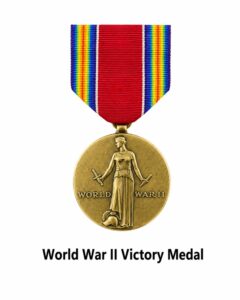
The World War II Victory Medal is one of the most widely recognized United States military decorations awarded for service during the Second World War. Unlike campaign medals that recognized participation in a specific theater or military operation, the World War II Victory Medal was awarded to nearly every member of the U.S. Armed Forces who served honorably during the war. It symbolizes the collective effort of millions of Americans who answered the nation’s call to duty during one of history’s most significant global conflicts.
Established shortly after Allied victory, the medal honors military personnel whose service contributed to the defeat of the Axis powers. Whether serving in combat overseas, defending the homeland, transporting troops and supplies, providing medical care, or supporting military operations from behind the front lines, every recipient played a role in achieving victory.
Today, the World War II Victory Medal remains one of the most meaningful decorations awarded to members of what is often called the “Greatest Generation.”
History of the World War II Victory Medal
As World War II drew to a close in 1945, the United States recognized the need for a decoration that honored all military personnel who served during the conflict, regardless of where they were assigned. On July 6, 1945, Congress authorized the creation of the World War II Victory Medal, and President Harry S. Truman later approved its issuance.
Unlike theater-specific campaign medals such as the American Campaign Medal, the Asiatic-Pacific Campaign Medal, and the European-African-Middle Eastern Campaign Medal, the World War II Victory Medal recognized honorable service performed anywhere during the official wartime period.
The medal became one of the most commonly awarded military decorations in U.S. history, reflecting the unprecedented size of America’s armed forces during World War II.
Eligibility Requirements
The World War II Victory Medal was awarded to all members of the U.S. Armed Forces who served on active duty or as members of the Reserve components during the qualifying period.
Eligible branches included:
- U.S. Army
- U.S. Navy
- U.S. Marine Corps
- U.S. Coast Guard
- Army Air Forces
The official qualifying dates are:
December 7, 1941 – December 31, 1946
Unlike many military decorations, there were no minimum time-in-service requirements beyond honorable service during the eligibility period. Personnel did not have to serve in combat or deploy overseas to qualify.
This broad eligibility recognized that victory depended upon the combined efforts of combat forces and the millions of military personnel supporting operations around the world.
Medal Design
The World War II Victory Medal features a bronze medallion rich with symbolism honoring the Allied victory.
The obverse depicts the figure of Liberation, standing confidently with one foot on a helmet while holding the broken hilt of a sword in one hand and the broken blade in the other. The design represents the defeat of tyranny and the restoration of peace following years of global conflict.
The reverse bears the inscription:
WORLD WAR II
Above the words appears a wreath and the message:
UNITED STATES OF AMERICA 1941–1945
The ribbon is equally distinctive, featuring a double rainbow design with narrow stripes of red, orange, yellow, green, blue, and violet surrounding a broad red center. The rainbow symbolizes hope and peace following victory, while the red center represents the sacrifice made by millions of service members during the war.
The colorful ribbon makes the World War II Victory Medal one of the easiest U.S. military decorations to identify.
Service During World War II
Recipients of the World War II Victory Medal served during one of the largest military mobilizations in American history.
Military personnel participated in countless roles, including:
- Front-line combat
- Amphibious landings
- Strategic bombing campaigns
- Naval convoy escort missions
- Intelligence operations
- Engineering and construction
- Medical support
- Logistics and transportation
- Aircraft maintenance
- Communications
- Military training
- Occupation duties following the war
Every assignment contributed to the overall success of Allied military operations.
Relationship to Other World War II Medals
Many veterans who received the World War II Victory Medal also earned one or more campaign medals based on where they served.
Common companion awards include:
- American Campaign Medal
- Asiatic-Pacific Campaign Medal
- European-African-Middle Eastern Campaign Medal
- American Defense Service Medal
- Army of Occupation Medal
- Navy Occupation Service Medal
Together, these decorations provide a detailed record of a veteran’s wartime service.
Order of Precedence
The World War II Victory Medal occupies an important place in the order of precedence for U.S. military decorations.
It is generally worn after the World War II campaign medals and before post-war occupation medals, reflecting its role as the universal service medal recognizing honorable military service during World War II.
Because it is not a campaign-specific award, no campaign stars or additional service devices are authorized for the medal itself.
Collecting the World War II Victory Medal
The World War II Victory Medal remains one of the most collected military decorations due to its historical significance and connection to America’s wartime generation.
Collectors typically evaluate:
- Original wartime ribbon
- Manufacturer markings
- Suspension brooch style
- Medal finish
- Named or documented provenance
- Original presentation cases
While the medal is relatively common, examples with complete documentation, original packaging, or connection to notable veterans often carry greater historical interest and collector value.
As with any military collectible, verifying authenticity and manufacturer marks can help distinguish original wartime issues from later replacements or reproductions.
Why the World War II Victory Medal Matters
The World War II Victory Medal represents more than military service—it symbolizes the determination, sacrifice, and unity that defined an entire generation. More than 16 million Americans served in uniform during World War II, contributing to one of the largest military efforts in history.
Whether serving in Europe, North Africa, the Pacific, the Atlantic, or within the United States, every recipient helped support the Allied victory that ended the war. The medal recognizes combat veterans, support personnel, reservists, and countless others whose dedication ensured mission success.
For families, historians, and collectors, the World War II Victory Medal serves as a lasting reminder of the courage and commitment of those who defended freedom during one of history’s most consequential conflicts.
Frequently Asked Questions
Who was eligible for the World War II Victory Medal?
Any member of the U.S. Armed Forces who served honorably between December 7, 1941, and December 31, 1946, was eligible to receive the medal.
Did recipients have to serve in combat?
No. The medal recognized honorable military service during the qualifying period, regardless of whether the service member deployed overseas or participated in combat.
Are campaign stars authorized on the World War II Victory Medal?
No. The World War II Victory Medal is not a campaign medal, so campaign stars and similar devices are not authorized for the ribbon.
Is the World War II Victory Medal still awarded?
No. It is a historical military decoration issued only for qualifying service during World War II.
Why is the ribbon designed like a rainbow?
The rainbow pattern symbolizes the hope, peace, and unity that followed the Allied victory, while the red center represents the sacrifice made by millions of service members during the war.