
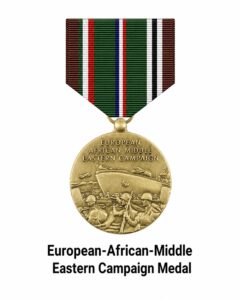
The European-African-Middle Eastern Campaign Medal (EAME Campaign Medal) is one of the most recognizable United States military decorations awarded for service during World War II. The medal honors members of the U.S. Armed Forces who participated in military operations throughout Europe, North Africa, and the Middle East between 1941 and 1946.
Recipients of this prestigious campaign medal served during some of history’s most significant military operations, including the North African Campaign, the invasion of Sicily, the Normandy landings on D-Day, the Battle of the Bulge, the liberation of France, and the final advance into Germany. Whether fighting on the front lines, flying bombing missions over occupied Europe, escorting convoys across the Atlantic, or providing logistical support, these service members played a vital role in the Allied victory over Nazi Germany and Fascist Italy.
Today, the European-African-Middle Eastern Campaign Medal stands as a lasting tribute to the courage and sacrifice of the millions who served in the European Theater during World War II.
History of the European-African-Middle Eastern Campaign Medal
The European-African-Middle Eastern Campaign Medal was established by President Franklin D. Roosevelt through Executive Order 9265 on November 6, 1942. It was created alongside the American Campaign Medal and the Asiatic-Pacific Campaign Medal to recognize service in the three major theaters of World War II.
The qualifying period extends from December 7, 1941, through March 2, 1946, encompassing nearly the entire American involvement in the war.
The medal recognizes participation in operations across an enormous geographic area that included:
- Europe
- North Africa
- The Mediterranean
- The Middle East
- Atlantic convoy routes supporting European operations
The campaign involved thousands of military units operating across land, sea, and air in one of history’s largest multinational military efforts.
Eligibility Requirements
The European-African-Middle Eastern Campaign Medal was awarded to members of the U.S. Armed Forces who performed qualifying service within the designated theater.
Eligible recipients included members of the:
- U.S. Army
- U.S. Navy
- U.S. Marine Corps
- U.S. Coast Guard
- Army Air Forces
Military personnel generally qualified by:
- Serving on permanent assignment within the theater.
- Participating in combat operations.
- Serving aboard ships operating in designated waters.
- Flying operational combat missions.
- Meeting temporary duty requirements.
- Participating in amphibious assaults or military campaigns.
Many veterans earned the medal while serving throughout multiple countries and combat operations across Europe and North Africa.
Campaign Stars
The European-African-Middle Eastern Campaign Medal is commonly seen with bronze service stars attached to its ribbon.
Each bronze service star represents participation in one officially recognized campaign. A silver service star replaces five bronze service stars.
Campaign participation could include operations such as:
- Normandy
- Northern France
- Rhineland
- Ardennes-Alsace
- Central Europe
- Sicily
- Naples-Foggia
- Rome-Arno
- Southern France
- Tunisia
- Algeria-French Morocco
Some veterans accumulated numerous campaign stars after serving through multiple invasions and offensives.
Medal Design
The European-African-Middle Eastern Campaign Medal features a bronze medallion designed to symbolize Allied military operations.
The obverse depicts an American landing craft approaching an enemy shoreline while troops advance under heavy air support. In the background are naval vessels, aircraft, and military equipment representing the joint operations that characterized the European campaign.
The reverse displays the traditional World War II design of a bald eagle standing proudly above the dates 1941–1945, symbolizing American victory.
The ribbon features a green center with brown, white, black, red, and blue stripes representing the varied landscapes and military forces involved throughout Europe, North Africa, and the Middle East.
Major Campaigns Recognized
The European-African-Middle Eastern Campaign Medal covers some of the most famous battles in military history.
Operations recognized include:
- Operation Torch
- Sicily Campaign
- Italian Campaign
- D-Day (Operation Overlord)
- Battle of Normandy
- Operation Market Garden
- Battle of the Bulge
- Crossing of the Rhine
- Liberation of Paris
- Final offensive into Germany
Naval forces also earned the medal while protecting Allied shipping lanes across the Atlantic and Mediterranean.
Order of Precedence
The European-African-Middle Eastern Campaign Medal is worn after the Asiatic-Pacific Campaign Medal and before the World War II Victory Medal in the order of precedence for World War II service medals.
Campaign stars remain attached to the suspension ribbon and service ribbon to denote participation in multiple campaigns.
Collecting the European-African-Middle Eastern Campaign Medal
Because millions of American service members served in Europe during World War II, the EAME Campaign Medal remains a cornerstone of many military collections.
Collectors typically examine:
- Original manufacturer markings
- Correct wartime ribbon
- Authentic suspension hardware
- Campaign stars
- Named or documented provenance
- Original issue brooch
Medals accompanied by discharge papers, award certificates, photographs, or documented campaign participation are especially desirable and help preserve the veteran’s personal history.
Why the European-African-Middle Eastern Campaign Medal Matters
Few military decorations represent as much history as the European-African-Middle Eastern Campaign Medal. It symbolizes the determination of Allied forces who fought across deserts, mountains, forests, beaches, and cities to defeat tyranny during World War II.
The medal honors not only those who stormed the beaches of Normandy or fought during the Battle of the Bulge, but also the pilots, sailors, engineers, medics, mechanics, and countless support personnel whose dedication made Allied victory possible.
For veterans and their families, the medal serves as a lasting reminder of extraordinary service during one of the defining conflicts of the twentieth century. For collectors and historians, it represents the courage, sacrifice, and global cooperation that ultimately secured freedom across Europe.
Frequently Asked Questions
Who was eligible for the European-African-Middle Eastern Campaign Medal?
Members of the U.S. Armed Forces who performed qualifying service in Europe, North Africa, or the Middle East between December 7, 1941, and March 2, 1946.
What do the bronze service stars represent?
Each bronze service star indicates participation in one officially designated military campaign.
Can a silver service star replace bronze stars?
Yes. One silver service star is worn in place of five bronze service stars.
Was the medal awarded to all military branches?
Yes. Eligible members of the Army, Navy, Marine Corps, Coast Guard, and Army Air Forces could receive the medal.
Is the European-African-Middle Eastern Campaign Medal still awarded?
No. It is a historical World War II campaign medal awarded only for qualifying wartime service.
Related Articles
- Bronze Service Star
- Military Ribbon Device Identification Guide
- American Defense Service Medal
- American Campaign Medal
- Asiatic-Pacific Campaign Medal
- European-African-Middle Eastern Campaign Medal
- Navy Occupation Service Medal
- World War II Campaign Medals
- Military Medal Manufacturer Marks
- Original vs. Reproduction Military Medals
- World War II Victory Medal