
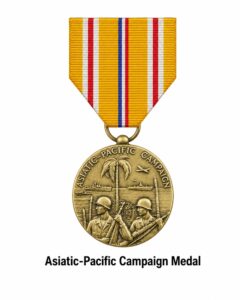
The Asiatic-Pacific Campaign Medal is a United States military decoration awarded to service members who participated in military operations within the Asiatic-Pacific Theater during World War II. Established during the war, the medal recognizes the courage, sacrifice, and dedication of millions of American military personnel who fought across one of the largest and most challenging combat theaters in history.
From the attack on Pearl Harbor to the final surrender of Japan, the Asiatic-Pacific Theater included countless battles fought across thousands of miles of ocean and hundreds of islands. Soldiers, sailors, Marines, Coast Guardsmen, and airmen endured difficult climates, dense jungles, volcanic terrain, and fierce enemy resistance throughout nearly four years of continuous combat. The Asiatic-Pacific Campaign Medal honors those who served in these historic operations.
History of the Asiatic-Pacific Campaign Medal
The Asiatic-Pacific Campaign Medal was established by President Franklin D. Roosevelt through Executive Order 9265 on November 6, 1942. It was created alongside the American Campaign Medal and the European-African-Middle Eastern Campaign Medal to recognize military service in the three principal theaters of World War II.
The medal acknowledges service performed in the Pacific and Asian regions between December 7, 1941, and March 2, 1946. During this period, Allied forces fought to halt Japanese expansion, reclaim occupied territory, and ultimately secure victory across the Pacific.
The campaign included numerous famous battles such as:
- Pearl Harbor
- Guadalcanal
- Midway
- Tarawa
- Saipan
- Iwo Jima
- Okinawa
- The Philippine Campaign
Each operation played an important role in the Allied advance toward Japan.
Eligibility Requirements
The Asiatic-Pacific Campaign Medal was awarded to members of the U.S. Armed Forces who served in the Asiatic-Pacific Theater during the qualifying period.
Eligible branches included:
- U.S. Army
- U.S. Navy
- U.S. Marine Corps
- U.S. Coast Guard
- Army Air Forces
Service members generally qualified through:
- Permanent assignment within the theater.
- Service aboard ships operating in designated waters.
- Participation in combat operations.
- Temporary duty meeting established time requirements.
- Aircrew participation in operational missions.
- Support of amphibious landings or military campaigns.
Many recipients served for months or years throughout the Pacific islands and surrounding waters.
Campaign Stars
One of the defining features of the Asiatic-Pacific Campaign Medal is the use of bronze service stars.
Each bronze service star represents participation in an officially designated military campaign. A silver service star is worn in place of five bronze service stars.
Campaigns recognized for the medal include operations such as:
- Central Pacific
- Eastern Mandates
- New Guinea
- Luzon
- Southern Philippines
- Ryukyus
- Western Pacific
Some veterans accumulated numerous campaign stars after serving in multiple operations throughout the war.
Medal Design
The Asiatic-Pacific Campaign Medal features a bronze medallion filled with symbols representing the Pacific War.
The obverse depicts a tropical landing scene with a Navy aircraft carrier, battleship, landing craft, palm trees, and troops moving ashore. The design reflects the amphibious operations that became a hallmark of the Pacific campaign.
The reverse displays a bald eagle standing above the dates 1941–1945, symbolizing American victory and national strength.
The ribbon features a striking color pattern:
- Yellow center symbolizing the Pacific.
- Narrow stripes of red and white.
- Blue stripes representing the United States.
- White, green, and additional colored stripes symbolizing the varied regions of the theater.
Its colorful ribbon is one of the most recognizable among World War II campaign medals.
Major Operations Recognized
The Asiatic-Pacific Campaign Medal represents service during many of the defining battles of World War II.
Recipients participated in operations involving:
- Amphibious invasions
- Naval engagements
- Carrier aviation
- Strategic bombing missions
- Island-hopping campaigns
- Convoy escort operations
- Jungle warfare
- Occupation and liberation missions
These campaigns gradually pushed Allied forces closer to Japan and ultimately led to the end of the war in the Pacific.
Order of Precedence
The Asiatic-Pacific Campaign Medal occupies an important position among World War II campaign awards.
For U.S. military personnel, it is generally worn after the American Campaign Medal and before the World War II Victory Medal.
Campaign stars attached to the ribbon provide additional recognition for participation in multiple military operations.
Collecting the Asiatic-Pacific Campaign Medal
The Asiatic-Pacific Campaign Medal is among the most collected U.S. military decorations from World War II.
Collectors often evaluate:
- Original ribbon colors
- Manufacturer markings
- Suspension hardware
- Campaign stars
- Original brooch type
- Named or documented provenance
Medals accompanied by official military records or awarded in large campaign groups are especially desirable.
Because campaign stars tell the story of a veteran’s service, original ribbon devices can significantly enhance both historical interest and collector value.
Why the Asiatic-Pacific Campaign Medal Matters
The Asiatic-Pacific Campaign Medal commemorates one of the most demanding military campaigns in American history. Service members endured tropical diseases, extreme heat, relentless combat, and dangerous sea and air operations across thousands of miles of ocean.
The medal recognizes not only those who fought in famous battles like Iwo Jima and Okinawa but also the countless support personnel who transported supplies, maintained aircraft, escorted convoys, built airfields, and kept Allied operations moving forward.
Today, it remains one of the defining decorations of World War II and serves as a lasting tribute to the veterans whose service helped secure victory in the Pacific.
Frequently Asked Questions
Who was eligible for the Asiatic-Pacific Campaign Medal?
Members of the U.S. Armed Forces who performed qualifying service in the Asiatic-Pacific Theater between December 7, 1941, and March 2, 1946.
What do the bronze stars on the medal represent?
Each bronze service star represents participation in an officially designated World War II campaign within the Asiatic-Pacific Theater.
Can a silver service star replace bronze stars?
Yes. One silver service star is worn instead of five bronze service stars.
Was the medal awarded to all military branches?
Yes. Eligible members of the Army, Navy, Marine Corps, Coast Guard, and Army Air Forces could receive the medal.
Is the Asiatic-Pacific Campaign Medal still awarded?
No. It is a historical military decoration issued only for qualifying World War II service.
Related Articles
- Bronze Service Star
- Military Ribbon Device Identification Guide
- American Defense Service Medal
- American Campaign Medal
- Asiatic-Pacific Campaign Medal
- European-African-Middle Eastern Campaign Medal
- Navy Occupation Service Medal
- World War II Campaign Medals
- Military Medal Manufacturer Marks
- Original vs. Reproduction Military Medals
- World War II Victory Medal