
Eligibility, History & Collecting Guide
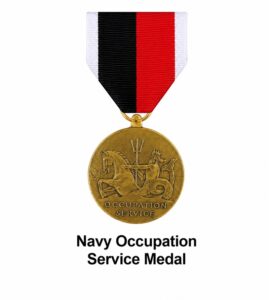
The Navy Occupation Service Medal is a United States military service medal awarded to members of the U.S. Navy, Marine Corps, and Coast Guard who performed qualifying occupation duty following World War II. Established after the war, the medal honors those who served during the reconstruction and stabilization of former enemy territories, helping transform wartime victories into lasting peace.
While combat had ended, the work of occupation forces had only begun. Sailors and Marines supported military governments, enforced surrender terms, protected strategic installations, cleared mines, delivered humanitarian aid, and helped rebuild nations devastated by years of conflict. Today, the Navy Occupation Service Medal remains an important decoration for military historians, veterans, and collectors alike.
History of the Navy Occupation Service Medal
At the conclusion of World War II in 1945, the United States assumed responsibility for occupation duties in Japan and parts of Europe. Naval forces played a significant role in maintaining security, transporting occupation personnel, supporting reconstruction efforts, and ensuring the peaceful transition from wartime governments.
To recognize this important service, the Navy Occupation Service Medal was established on January 22, 1948. Unlike campaign medals recognizing combat operations, this award honors military personnel whose service contributed to maintaining peace after hostilities had ceased.
The occupation of Japan continued for several years, while naval personnel also participated in occupation activities in Europe immediately following Germany’s surrender.
Eligibility Requirements
Eligibility for the Navy Occupation Service Medal generally required:
- Active duty with the U.S. Navy, Marine Corps, or Coast Guard
- Assignment to an authorized occupation force
- 30 consecutive days of qualifying occupation service
- Service within officially designated occupation areas during approved dates
Only personnel assigned to qualifying commands or units were eligible for the decoration.
Europe Clasp
Service members assigned to occupation duty in Europe received the medal with the EUROPE clasp.
Qualifying service included occupation operations in:
- Germany
- Austria
- Italy
- Trieste
- Other designated European occupation areas
The clasp is attached to the suspension ribbon of the full-size medal.
Asia Clasp
Personnel serving in occupied Japan or nearby designated areas received the ASIA clasp.
Qualifying service included assignments in:
- Japan
- Japanese home islands
- Certain surrounding occupation areas
- Designated naval occupation commands
The Asia Clasp distinguishes service performed in the Pacific theater following Japan’s surrender.
Occupation Duties
Occupation forces performed a wide range of responsibilities that extended far beyond traditional military operations.
Common duties included:
- Harbor security
- Mine-clearing support
- Transportation of occupation forces
- Protection of naval facilities
- Humanitarian assistance
- Maritime patrols
- Enforcement of occupation regulations
- Support for military government operations
These missions helped establish security while allowing civilian governments to recover from the devastation of war.
Medal Design
The Navy Occupation Service Medal is a bronze medal measuring approximately 1¼ inches in diameter.
Obverse
The front features Neptune, the Roman god of the sea, mounted on a hippocampus while holding a trident. This powerful maritime image symbolizes the Navy’s role in securing peace across the world’s oceans.
Reverse
The reverse displays:
- The words OCCUPATION SERVICE
- An anchor
- Laurel branches
- The inscription UNITED STATES NAVY
The design reflects both military achievement and the restoration of peace.
Ribbon Design
The ribbon features a distinctive combination of colors that makes it easily recognizable.
Its colors include:
- Red
- Black
- White
- Green
The balanced arrangement symbolizes both wartime sacrifice and the transition to peace through occupation service.
The Europe or Asia clasp identifies the recipient’s qualifying theater of service.
Authorized Clasps
Only two clasps were authorized for the Navy Occupation Service Medal:
- EUROPE
- ASIA
Only one clasp may be worn on the medal.
No campaign stars or service stars are authorized for this decoration.
Coast Guard Eligibility
Members of the U.S. Coast Guard qualified for the Navy Occupation Service Medal when serving under Navy operational control during authorized occupation missions.
This reflects the close cooperation between the sea services during post-war operations.
Difference Between the Navy and Army Occupation Medals
Although both medals recognize occupation service after World War II, they are awarded by different military branches.
The Army of Occupation Medal recognizes Army personnel serving under Army occupation commands.
The Navy Occupation Service Medal recognizes Navy, Marine Corps, and eligible Coast Guard personnel serving with naval occupation forces.
Each has its own ribbon, medal design, and eligibility regulations.
Collecting the Navy Occupation Service Medal
Collectors value the Navy Occupation Service Medal because it represents a unique period in naval history.
Desirable examples include:
- Original issue medals
- Europe Clasp
- Asia Clasp
- Original presentation boxes
- Named medal groups
- Matching service records
- Veteran photographs
Complete occupation groups documenting service aboard occupation ships or with Marine occupation units often command greater collector interest.
Identifying Original Medals
Authentic medals typically feature:
- Sharp strike quality
- Well-defined Neptune design
- Correct bronze finish
- High-quality ribbon material
- Proper clasp attachment
- Manufacturer markings on some issues
Collectors should be cautious of reproduction medals that may have incorrect ribbon colors, poor casting details, or lightweight construction.
Historical Importance
Occupation forces helped establish stability during one of the most important transitions in modern history.
Naval personnel contributed by:
- Securing ports
- Delivering supplies
- Supporting reconstruction
- Protecting shipping lanes
- Assisting occupation governments
- Maintaining regional security
Their efforts helped lay the foundation for lasting peace and strong alliances throughout Europe and the Pacific.
Frequently Asked Questions
Is the Navy Occupation Service Medal a combat medal?
No. It recognizes qualifying occupation service performed after combat operations ended.
Who could receive the medal?
Eligible members of the U.S. Navy, Marine Corps, and qualifying Coast Guard personnel.
How long did someone need to serve?
Generally, recipients completed 30 consecutive days of qualifying occupation duty.
What clasps were authorized?
The medal was authorized with either the EUROPE clasp or the ASIA clasp, depending on the location of service.
Is the Navy Occupation Service Medal still awarded?
No. The qualifying occupation periods ended many years ago, making the medal a historical military decoration.
Conclusion
The Navy Occupation Service Medal commemorates the sailors, Marines, and Coast Guardsmen who served during the vital post-World War II occupation of Europe and Asia. Their missions ensured security, supported reconstruction, and helped transform former battlefields into stable allies. As both a military decoration and a collector’s item, the medal remains a lasting reminder that achieving peace requires dedication long after the fighting has ended.