
Eligibility, History & Collecting Guide
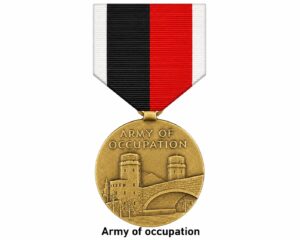
The Army of Occupation Medal is a United States Army campaign medal awarded to military personnel who served as part of occupation forces following World War II. Established to recognize the critical mission of maintaining peace, rebuilding devastated nations, and supporting military government operations, the medal honors soldiers who helped shape the post-war world.
Unlike combat decorations, the Army of Occupation Medal recognizes service performed after hostilities ended. Soldiers stationed in Germany, Austria, Italy, Japan, and Korea played an essential role in restoring order, supervising reconstruction, and ensuring long-term regional stability. Today, the medal remains an important piece of military history and is highly valued by veterans, historians, and collectors.
History of the Army of Occupation Medal
Following the surrender of Germany in May 1945 and Japan in September 1945, the United States maintained military forces in occupied territories to oversee reconstruction and enforce the terms of surrender.
Recognizing the importance of these missions, President Harry S. Truman established the Army of Occupation Medal by Executive Order 9586 on April 8, 1946.
The medal acknowledges that occupation duty required professionalism, discipline, and long-term commitment. Soldiers were responsible for everything from disarming former enemy forces to supporting humanitarian efforts, rebuilding infrastructure, and assisting civilian governments.
Occupation forces remained in several countries for years after the war, making this one of the most significant post-war service medals in U.S. military history.
Eligibility Requirements
To qualify for the Army of Occupation Medal, service members generally had to complete:
- 30 consecutive days of occupation duty
- Assignment within an officially designated occupation area
- Service after World War II under qualifying Army commands
Eligibility varied depending on the occupation zone and service dates established by the Department of the Army.
Qualifying locations included:
- Germany
- Austria
- Italy
- Berlin
- Japan
- Korea
Personnel serving temporary duty generally did not qualify unless specific requirements were met.
Germany Clasp
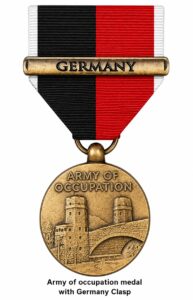
Most recipients earned the medal with the Germany Clasp.
This clasp recognized occupation service in:
- American Zone of Germany
- Berlin
- Austria
- Italy (during qualifying periods)
The clasp is attached to the suspension ribbon of the full-size medal and displays the word:
GERMANY
When wearing only the service ribbon, no clasp is worn.
Japan Clasp
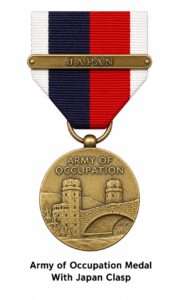
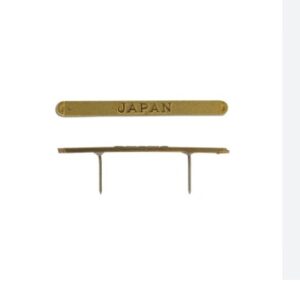
Service members assigned to occupied Japan received the medal with the Japan Clasp.
Qualifying service included duty in:
- Japanese home islands
- Ryukyu Islands (during qualifying periods)
- Other designated occupation areas
The clasp is engraved with:
JAPAN
Only one clasp is authorized depending on the qualifying occupation area.
Service in Korea
Before the Korean War officially began in 1950, some U.S. Army personnel performed occupation duties in southern Korea.
These soldiers could qualify for the Army of Occupation Medal with the Japan Clasp because Korea fell under U.S. occupation authorities during the immediate post-war period.
This makes early occupation service in Korea distinct from later Korean War service recognized by the Korean Service Medal.
Medal Design
The Army of Occupation Medal is struck in bronze and measures approximately 1¼ inches in diameter.
Obverse
The front depicts:
- Mount Fuji
- Two Japanese junks sailing across the water
- A low-hanging cloud above the mountain
Although Mount Fuji represents Japan, the same medal is awarded regardless of occupation area. The clasp identifies whether the recipient served in Germany or Japan.
Reverse
The reverse displays:
- An ancient bridge
- Two sprigs of laurel
- The inscription:
ARMY OF OCCUPATION
The design symbolizes peace, stability, and reconstruction after war.
Ribbon Design
The ribbon is one of the medal’s most recognizable features.
Its colors include:
- Black
- Scarlet
- White
- Red
- White
- Black
The contrasting colors represent the transition from war to peace and distinguish the decoration from other post-World War II service medals.
Collectors often identify the medal quickly by its unique ribbon pattern.
Authorized Devices
Unlike many campaign medals, the Army of Occupation Medal has relatively few authorized devices.
These include:
- Germany Clasp
- Japan Clasp
No campaign stars or service stars are authorized for this decoration.
Only one clasp may be worn on the full-size medal.
Difference Between the Army and Navy Occupation Medals
Although similar in purpose, the Army of Occupation Medal differs from the Navy Occupation Service Medal.
The Army medal recognizes soldiers serving under Army occupation commands, while the Navy award honors sailors and Marines serving with naval occupation forces.
Each medal has unique eligibility requirements, ribbon designs, and governing regulations.
Collectors should avoid confusing the two since they represent different branches of service.
Collecting the Army of Occupation Medal
The Army of Occupation Medal is widely collected because of its direct connection to the rebuilding of Europe and Japan.
Collectors often seek examples featuring:
- Original ribbon
- Germany Clasp
- Japan Clasp
- Original issue box
- Lapel button
- Named award sets
- Accompanying discharge papers
Named groups that include occupation documents or photographs are especially desirable because they establish the veteran’s service history.
Identifying Original Medals
Authentic Army of Occupation Medals generally feature:
- Sharp, detailed engraving
- Crisp lettering
- High-quality bronze construction
- Correct ribbon colors
- Proper suspension hardware
- Manufacturer markings on some examples
Modern reproductions often have softer details, thinner metal, incorrect ribbon shades, or lightweight construction.
Collectors should compare suspected reproductions with verified original examples before purchasing.
Historical Importance
Occupation duty required American soldiers to transition from combat operations to peacekeeping.
Their responsibilities included:
- Maintaining public order
- Supervising demilitarization
- Supporting displaced civilians
- Protecting strategic facilities
- Assisting local governments
- Promoting democratic institutions
The success of these missions helped lay the foundation for lasting alliances with Germany and Japan that continue today.
Frequently Asked Questions
Is the Army of Occupation Medal a combat medal?
No. It recognizes qualifying occupation service after combat operations had ended.
How many days were required to qualify?
Most recipients needed 30 consecutive days in an authorized occupation area.
Can someone receive both Germany and Japan Clasps?
No. Only one clasp is worn on the medal based on qualifying service.
Does occupation service in Korea qualify?
Yes, certain service in Korea before the Korean War qualified under occupation regulations.
Is the medal still awarded?
No. The qualifying occupation periods ended decades ago, making the medal a historical U.S. military decoration.
Conclusion
The Army of Occupation Medal recognizes the soldiers who helped secure peace after one of history’s largest conflicts. Their work extended far beyond military victory, supporting reconstruction, humanitarian assistance, and the establishment of stable governments across Europe and Asia. For veterans, descendants, and military collectors, the medal represents a remarkable chapter in U.S. Army history and remains an enduring symbol of service during the transition from war to lasting peace.