
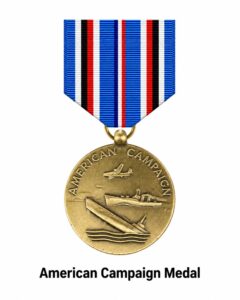
The American Campaign Medal is a United States military decoration established during World War II to recognize service members who performed qualifying duty within the American Theater of Operations between 1941 and 1946. Although it is often overshadowed by combat medals earned overseas, the American Campaign Medal honors the essential work performed in defense of the United States and surrounding territories during one of the nation’s most challenging periods.
Thousands of service members protected coastlines, escorted convoys, patrolled American waters, defended strategic bases, transported troops and supplies, and supported military operations that were critical to Allied victory. Whether serving aboard naval vessels, in coastal defense units, or on military installations across the Western Hemisphere, recipients of the American Campaign Medal helped safeguard the homeland and ensure the success of operations abroad.
History of the American Campaign Medal
The American Campaign Medal was established by President Franklin D. Roosevelt through Executive Order 9265 on November 6, 1942. While the medal was authorized during the war, its purpose was to recognize military service performed throughout the American Theater during World War II.
Unlike campaign medals awarded for specific battles, the American Campaign Medal recognizes extended service in the defense of the Western Hemisphere. During the war, German U-boats threatened merchant shipping along the Atlantic Coast, Japanese attacks raised concerns throughout the Pacific, and military forces remained on constant alert to protect ports, airfields, industrial centers, and transportation routes.
The American Theater extended far beyond the continental United States and included surrounding waters, Alaska, portions of the Caribbean, the Gulf of Mexico, Newfoundland, Greenland, and other designated operational areas. Service in these regions was essential to maintaining secure supply lines that supported Allied operations in Europe, North Africa, and the Pacific.
Eligibility Requirements
The American Campaign Medal was awarded to members of the U.S. Armed Forces who served in the American Theater between December 7, 1941, and March 2, 1946.
Service members generally qualified by meeting one of several requirements, including:
- Permanent assignment outside the continental United States but within the American Theater.
- Service aboard a vessel operating in designated waters.
- Active participation in anti-submarine patrols or escort missions.
- Temporary duty within the theater for the required number of consecutive or non-consecutive days.
- Active combat against enemy forces within the American Theater.
Eligibility applied to members of the:
- U.S. Army
- U.S. Navy
- U.S. Marine Corps
- U.S. Coast Guard
- Army Air Forces
Many personnel earned the medal through months of routine but essential duty that ensured the security of North America throughout the war.
The American Theater of Operations
Many people assume World War II combat occurred only overseas, but enemy action also reached the American Theater.
German submarines attacked merchant ships along the East Coast and in the Gulf of Mexico. Naval aircraft conducted anti-submarine patrols across the Atlantic, while Coast Guard crews protected harbors and escorted convoys carrying troops and military supplies.
Military personnel also defended:
- Alaska
- The Aleutian Islands
- Caribbean bases
- Canal Zone facilities
- Coastal artillery positions
- Air defense installations
- Naval shipyards
- Military training facilities
These operations ensured that supplies continued flowing to Allied forces fighting overseas.
Medal Design
The American Campaign Medal features a bronze medallion rich in World War II symbolism.
The obverse depicts a Navy cruiser sailing beneath a B-24 Liberator bomber, with a sinking enemy submarine in the foreground. The design represents the combined efforts of America’s naval and air forces to protect shipping lanes and defeat enemy submarines.
The reverse displays a bald eagle standing proudly above the date 1941–1945, symbolizing the nation’s strength and ultimate victory during World War II.
The ribbon consists primarily of a blue center representing the Atlantic Ocean, bordered by white, black, red, and white stripes on each side. The colors symbolize both the Atlantic and Pacific theaters while reflecting America’s worldwide defense mission during the conflict.
Service Stars and Devices
The American Campaign Medal generally did not receive campaign stars because it recognized service within a broad theater rather than individual campaigns.
However, qualifying military personnel could wear additional authorized devices when required by service regulations or if earned through related awards.
Collectors should always verify original ribbon devices, as many medals have been replaced or restored over the decades.
Order of Precedence
The American Campaign Medal occupies an important place among World War II service decorations.
For U.S. military personnel, it is worn after the American Defense Service Medal and before the Asiatic-Pacific Campaign Medal or the European-African-Middle Eastern Campaign Medal, depending on the individual’s service.
Its placement reflects its role as one of the principal World War II campaign medals awarded by the United States.
Collecting the American Campaign Medal
Original American Campaign Medals remain popular among military collectors because they represent the often-overlooked service performed within the Western Hemisphere during World War II.
When evaluating a medal, collectors should examine:
- Manufacturer markings
- Suspension style
- Ribbon quality
- Original brooch hardware
- Signs of restoration or reproduction
Well-preserved original medals with period ribbons and documented provenance are generally more desirable than modern replacements.
Why the American Campaign Medal Matters
Although many recipients never served in famous overseas battles, their contributions were vital to Allied victory. The American Campaign Medal recognizes the sailors protecting merchant convoys, Coast Guardsmen defending coastal waters, soldiers guarding military installations, airmen patrolling American skies, and countless support personnel whose work allowed combat operations around the world to continue.
Without secure ports, protected shipping lanes, functioning airfields, and uninterrupted logistics, Allied campaigns in Europe and the Pacific would have faced enormous challenges. The American Campaign Medal serves as a lasting reminder that victory depended not only on front-line combat but also on the dedicated service of those protecting the homeland.
Today, the medal remains an important part of World War II military history and is highly valued by veterans’ families, historians, and collectors seeking to preserve the legacy of the Greatest Generation.
Frequently Asked Questions
Who was eligible for the American Campaign Medal?
Members of the U.S. Armed Forces who served in the American Theater between December 7, 1941, and March 2, 1946, and met established service requirements were eligible.
Was the American Campaign Medal awarded for combat?
Not necessarily. Many recipients earned the medal through qualifying service in the American Theater without engaging directly in combat.
What areas were included in the American Theater?
The theater included the continental United States, Alaska, surrounding coastal waters, the Caribbean, Gulf of Mexico, Newfoundland, Greenland, and other designated operational areas.
Is the American Campaign Medal still awarded?
No. The medal was created specifically for qualifying service during World War II and is no longer awarded.
Is the American Campaign Medal valuable to collectors?
Yes. Original medals with authentic ribbons, manufacturer marks, and documented military history are highly sought after by collectors of World War II memorabilia.