
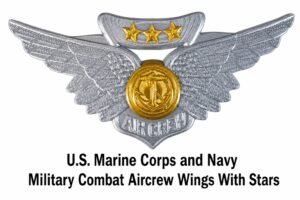
The U.S. Marine Corps and Navy Military Combat Aircrew Wings with Stars recognize enlisted and officer aircrew members who have demonstrated exceptional performance while participating in combat aviation operations. The addition of gold stars to the Combat Aircrew Wings signifies multiple combat deployments or additional qualifying combat missions, making this badge one of the most respected aviation warfare insignia worn by Navy and Marine Corps personnel.
These wings symbolize courage, professionalism, and dedication to supporting combat missions under hazardous conditions. Whether serving aboard helicopters, transport aircraft, patrol aircraft, or specialized aviation platforms, qualified aircrew members earn these wings through rigorous training and operational excellence.
History of the Combat Aircrew Wings
The Naval Aircrew insignia has evolved over several decades as aviation became increasingly important to military operations. During the Cold War and later conflicts such as Vietnam, Operation Desert Storm, Iraq, and Afghanistan, Navy and Marine Corps aviation personnel routinely operated in hostile environments.
To recognize those who flew combat missions, the Military Combat Aircrew Wings were authorized. Personnel who accumulated qualifying combat service received gold stars mounted above the wings to indicate additional combat achievements.
Today, these insignia remain a proud symbol of operational experience and combat readiness.
What the Combat Aircrew Wings Look Like
The Military Combat Aircrew Wings feature several distinctive elements:
- Silver outstretched wings
- A central gold anchor representing naval service
- “AIR CREW” displayed beneath the anchor
- Gold stars positioned above the wings
Each feature carries symbolic meaning.
The silver wings represent aviation service and flight operations.
The gold anchor reflects the Navy’s maritime heritage while also representing Marine Corps aviation operating as part of the naval service.
The stars signify additional qualifying combat achievements beyond the initial award.
What Do the Stars Mean?
One of the most common questions involves the stars displayed above the insignia.
Gold stars indicate additional combat qualifications or awards associated with combat aircrew service.
Although regulations have changed over time, stars generally represent repeated qualifying combat deployments or participation in designated combat operations.
For example:
- No stars – Initial Combat Aircrew qualification
- One gold star – One additional qualifying award
- Two gold stars – Two additional qualifying awards
- Three gold stars – Three additional qualifying awards
The exact criteria depend on the regulations that were in effect during the member’s period of service.
Who Can Earn Combat Aircrew Wings?
Combat Aircrew Wings are awarded to qualified personnel serving in aviation assignments where participation in combat flight operations is required.
Eligible personnel may include:
- Helicopter crew chiefs
- Flight engineers
- Rescue swimmers
- Tactical systems operators
- Loadmasters
- Airborne communications specialists
- Other designated Naval Aircrew members
Candidates must complete required training while demonstrating proficiency in assigned aviation duties.
Additional combat qualifications require documented participation in approved combat missions.
Combat Aircrew Training
Earning these wings requires extensive preparation.
Training generally includes:
- Aviation safety procedures
- Aircraft emergency operations
- Survival training
- Water survival
- Aircraft systems
- Crew coordination
- Mission procedures
- Combat readiness evaluations
Many Naval Aircrew personnel also complete specialized courses depending on their aircraft and mission.
This demanding training ensures every crew member can safely perform under combat conditions.
Marine Corps and Navy Aviation Missions
Combat Aircrew personnel support a wide variety of missions around the world.
These include:
- Combat assault operations
- Troop transport
- Medical evacuation
- Search and rescue
- Intelligence collection
- Maritime patrol
- Logistics support
- Special operations
- Humanitarian assistance
- Disaster relief
Even missions that begin as humanitarian operations can quickly become dangerous, requiring aircrew members to remain prepared for hostile environments.
Why These Wings Are Highly Respected
Combat Aircrew Wings represent much more than aviation service.
Unlike many qualification badges, Combat Aircrew Wings acknowledge actual operational participation in hazardous missions.
Recipients often spend hundreds or thousands of flight hours supporting military operations while facing enemy fire, severe weather, mechanical emergencies, and difficult flying conditions.
The addition of gold stars reflects repeated service in combat environments, making the insignia especially meaningful among Naval Aviation personnel.
Many veterans consider these wings among the most significant awards they earned during their careers.
Collecting Combat Aircrew Wings
Military insignia collectors often seek Combat Aircrew Wings because numerous versions exist.
Collectors frequently encounter:
- Sterling silver badges
- Pin-back versions
- Clutch-back versions
- Manufacturer variations
- Vintage Vietnam-era insignia
- Desert Storm-era examples
- Modern issue badges
- Wings with one, two, or three gold stars
Condition, manufacturer markings, age, and historical provenance all influence collector value.
Original military-issued examples generally command higher prices than commercial reproductions.
Preserving Military Aircrew Wings
Proper preservation helps protect these important pieces of military history.
Consider these best practices:
- Store in a dry environment
- Avoid excessive humidity
- Handle with clean hands
- Keep away from direct sunlight
- Use acid-free display materials
- Avoid abrasive polishing compounds
Veterans often display Combat Aircrew Wings inside military shadow boxes alongside medals, ribbons, challenge coins, photographs, and service certificates.
Conclusion
The U.S. Marine Corps and Navy Military Combat Aircrew Wings with Stars honor aviation professionals who served in demanding combat environments while supporting some of the military’s most critical missions. Every gold star represents additional operational experience earned through dedication, professionalism, and courage.
Whether displayed in a veteran’s collection, preserved in a family heirloom, or studied by military historians, these wings remain an enduring symbol of Naval Aviation excellence and combat service. Understanding their history and significance helps preserve the legacy of the Marines and Sailors who earned them through exceptional performance under some of the most challenging conditions imaginable.
Frequently Asked Questions
What do the stars on Combat Aircrew Wings mean?
Gold stars indicate additional qualifying combat awards or combat service beyond the initial Combat Aircrew qualification.
Can Marine Corps personnel wear Navy Combat Aircrew Wings?
Yes. Since the Marine Corps is part of the Department of the Navy, qualified Marine aviation personnel may earn and wear these wings.
Are Combat Aircrew Wings still awarded?
Yes. Qualified Naval Aircrew personnel continue to earn aircrew qualifications under current Navy regulations, although award criteria have evolved over time.
Are Combat Aircrew Wings considered medals?
No. They are qualification insignia or warfare devices, not military medals.
How can I identify an authentic Combat Aircrew Wings badge?
Look for military-quality construction, manufacturer hallmarks, proper attachment hardware, and, on older examples, sterling silver markings. Authentic badges generally have better craftsmanship than reproductions.