
A military ribbon rack tells the story of a service member’s career through a carefully arranged display of ribbons and award devices. Every ribbon represents a specific military award, while the order and attached devices provide additional information about combat service, deployments, achievements, campaign participation, and repeated awards.
At first glance, a ribbon rack may appear to be a collection of colorful stripes. However, once you understand how military ribbons are organized, you can identify many of the honors a service member has earned and gain a better understanding of their military experience.
What Is a Military Ribbon Rack?
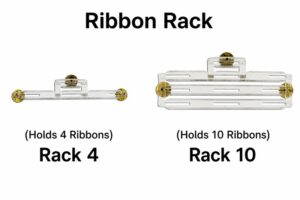
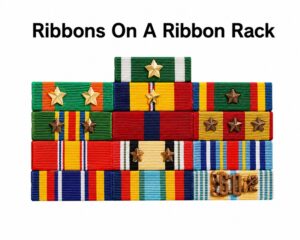
A military ribbon rack is a collection of service ribbons worn on military uniforms in place of full-sized medals during everyday duty.
Each ribbon represents an official military award, including:
- Personal decorations
- Campaign medals
- Service medals
- Unit awards
- Foreign decorations
- Training awards
Together, the ribbons provide a visual summary of a service member’s military accomplishments.
Why Ribbon Order Matters
Military ribbons are never placed randomly.
Every branch of the U.S. Armed Forces follows an official Order of Precedence, which determines where each ribbon is worn.
Generally:
- Personal decorations appear first.
- Valor awards are worn before service awards.
- Campaign medals follow personal decorations.
- Service medals come next.
- Unit awards follow.
- Foreign awards are usually worn last.
The higher the ribbon appears on the rack, the higher its precedence.
Reading the Ribbon Rack from Top to Bottom
Ribbon racks are read beginning with the top row, starting from the wearer’s right side (which appears on the left when you are facing them).
Continue reading:
- Top row first
- Right to left from the wearer’s perspective
- Then move to the next row below
This standardized arrangement allows every ribbon to be identified correctly.
Understanding Ribbon Colors
Each military ribbon has a unique combination of colors and stripe patterns.
When identifying a ribbon, pay attention to:
- Stripe colors
- Stripe width
- Stripe order
- Border colors
- Center stripes
Even ribbons with similar colors may represent completely different awards because of slight differences in their design.
Look for Award Devices
Many ribbons include small metal devices that provide additional information.
Common devices include:
Oak Leaf Clusters
Used primarily by the Army, Air Force, and Space Force to indicate additional awards of the same decoration.
Award Stars
Used mainly by the Navy, Marine Corps, and Coast Guard to show additional awards or campaign participation.
V Device
The bronze “V” identifies an award earned for valor or heroism during combat.
Arrowhead Device
The Arrowhead Device recognizes participation in a qualifying combat assault landing.
Numerals
Certain ribbons use numerals to indicate the total number of qualifying awards or periods of service.
Identifying Personal Decorations
Personal decorations recognize individual achievement, heroism, leadership, or meritorious service.
Examples include:
- Medal of Honor
- Distinguished Service Cross
- Silver Star
- Bronze Star Medal
- Purple Heart
- Meritorious Service Medal
- Commendation Medals
- Achievement Medals
These awards usually appear toward the beginning of the ribbon rack.
Identifying Campaign and Service Medals
Campaign medals recognize participation in specific military operations or conflicts.
Examples include:
- Vietnam Service Medal
- Southwest Asia Service Medal
- Afghanistan Campaign Medal
- Iraq Campaign Medal
Service medals recognize honorable military service during designated periods.
Examples include:
- National Defense Service Medal
- Armed Forces Service Medal
- Humanitarian Service Medal
These awards generally appear after personal decorations.
Recognizing Unit Awards
Unit awards honor entire military organizations for exceptional performance or heroism.
If a service member was assigned to the unit during the qualifying period, they may wear the unit award.
Examples include:
- Presidential Unit Citation
- Joint Meritorious Unit Award
- Navy Unit Commendation
- Air Force Outstanding Unit Award
Unit awards are worn after most personal and campaign decorations.
Foreign Awards
Some service members receive decorations from allied nations.
Foreign awards generally appear after U.S. military decorations and are worn according to military regulations.
These awards often recognize coalition operations, international cooperation, or joint military service.
What a Ribbon Rack Can Tell You
A properly arranged ribbon rack may reveal information such as:
- Combat experience
- Overseas deployments
- Participation in military campaigns
- Humanitarian missions
- Multiple awards
- Leadership recognition
- Length of military service
- Unit achievements
However, ribbons alone do not provide the complete history of a service member’s career.
Common Identification Mistakes
People often make mistakes when reading ribbon racks by:
- Reading rows in the wrong direction
- Ignoring award devices
- Confusing similar ribbon colors
- Assuming every medal indicates combat service
- Misidentifying campaign medals as personal decorations
Using an official ribbon chart greatly improves identification accuracy.
Helpful Identification Tips
When examining a ribbon rack:
- Start with the top row.
- Follow the official order of precedence.
- Compare ribbon colors carefully.
- Look for attached devices.
- Identify campaign and service medals separately.
- Consider the military branch and period of service.
Taking time to examine each ribbon individually makes identification much easier.
Frequently Asked Questions
Which ribbon appears first?
The highest-precedence personal decoration is worn first according to military regulations.
Can you identify someone’s entire military career from their ribbon rack?
No. A ribbon rack provides valuable information but does not show every assignment, duty station, qualification, or deployment.
What do the small metal devices mean?
Devices indicate additional awards, valor, campaign participation, assault landings, or repeated qualifying service, depending on the specific device.
Why do some ribbon racks look different?
Ribbon racks vary because each service member earns different awards based on their branch, assignments, deployments, achievements, and military career.
Conclusion
A military ribbon rack is much more than a display of colorful ribbons—it is a visual record of a service member’s accomplishments, deployments, achievements, and dedication to duty. By understanding the order of precedence, recognizing ribbon colors, and identifying award devices such as Oak Leaf Clusters, Award Stars, and the V Device, you can accurately interpret what a ribbon rack represents. Whether you’re researching military history, identifying a family member’s awards, or expanding your knowledge of U.S. military decorations, learning how to read a military ribbon rack is an essential skill.