 The Expert Infantryman Badge (EIB) is one of the most respected special skill badges awarded by the United States Army. It recognizes infantry Soldiers who demonstrate exceptional proficiency in infantry skills through a demanding series of physical and technical evaluations. Earning the EIB requires extensive preparation, discipline, and mastery of the core tasks expected of an infantry professional. Often considered one of the Army’s most challenging qualification badges, the Expert Infantryman Badge symbolizes technical excellence, tactical competence, and dedication to the infantry profession. Soldiers who wear the EIB have successfully completed rigorous testing designed to verify their knowledge, physical fitness, and battlefield skills.
History of the Expert Infantryman Badge
The Expert Infantryman Badge was established on October 27, 1943, during World War II.
Army leaders wanted a way to recognize infantry Soldiers who demonstrated superior proficiency in essential combat skills, even if they had not yet served in combat. The badge was intended to promote professional excellence and encourage continuous training throughout the infantry.
Since its creation, the EIB has become one of the Army’s most prestigious special skill badges.
Purpose of the Expert Infantryman Badge
The EIB recognizes Soldiers who have mastered the knowledge and practical skills required of an infantry professional.
The badge demonstrates proficiency in:
- Individual infantry skills
- Tactical operations
- Weapons handling
- Land navigation
- Physical fitness
- Battlefield medical tasks
- Communications
- Leadership under pressure
It serves as visible recognition of a Soldier’s commitment to professional excellence.
Who Is Eligible?
Eligibility is limited to Soldiers serving in qualifying infantry specialties.
General requirements include:
- Membership in the United States Army
- Assignment to an eligible infantry position
- Possession of a qualifying infantry Military Occupational Specialty (MOS)
- Meeting Army physical fitness and medical standards
- Successful completion of all required testing events
Eligibility requirements may change as Army regulations are updated.
EIB Testing Requirements
The testing process is intentionally demanding.
Candidates must demonstrate proficiency across numerous infantry tasks while working under strict time limits.
Common testing events include:
- Weapons qualification
- Land navigation
- Tactical movement
- Medical evacuation procedures
- Communications
- Grenade employment
- Patrol operations
- First aid
- Physical fitness evaluations
- Day and night operations
Each task is graded on a pass-or-fail basis.
Physical Demands
The EIB is physically challenging.
Candidates may complete:
- Long-distance foot marches
- Obstacle courses
- Equipment carries
- Combat movement drills
- Timed tactical events
Maintaining endurance while performing technical tasks is a critical part of the evaluation.
Expert Infantryman Badge Appearance
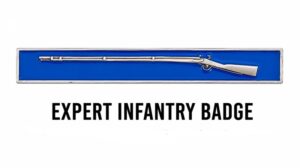
The Expert Infantryman Badge features a silver-colored musket mounted on a rectangular blue field surrounded by an oak wreath.
The musket represents the infantry branch, while the wreath symbolizes achievement and excellence.
The badge is immediately recognizable across the Army and is worn with pride by those who earn it.
Why the EIB Is Respected
The EIB has earned a reputation as one of the Army’s most difficult qualification badges because of its high standards and low pass rates during many testing cycles.
Recipients demonstrate:
- Technical competence
- Physical endurance
- Attention to detail
- Mental resilience
- Tactical expertise
- Professional discipline
For many infantry Soldiers, earning the badge is a major career milestone.
Difference Between the EIB and Combat Infantryman Badge
The Expert Infantryman Badge and the Combat Infantryman Badge (CIB) are often confused, but they recognize different accomplishments.
The EIB recognizes mastery of infantry skills demonstrated through testing.
The Combat Infantryman Badge (CIB) recognizes infantry Soldiers who have actively engaged in ground combat while assigned to qualifying units.
A Soldier may earn one or both badges if all eligibility requirements are met.
Importance of the Expert Infantryman Badge
The EIB reflects the Army’s commitment to maintaining highly trained infantry forces capable of performing demanding combat missions.
Although earning the badge requires significant preparation, recipients gain professional recognition throughout the Army and demonstrate their readiness to perform the core tasks of the infantry mission.
Frequently Asked Questions
Is the Expert Infantryman Badge a combat award?
No. The EIB recognizes technical proficiency and successful completion of rigorous testing, not combat service.
Who can earn the Expert Infantryman Badge?
Only Soldiers serving in qualifying infantry specialties who meet all eligibility requirements may compete for the badge.
Is the EIB difficult to earn?
Yes. The testing process is widely considered one of the Army’s most demanding skill evaluations.
Can a Soldier earn both the EIB and Combat Infantryman Badge?
Yes. Soldiers who qualify under the requirements for both badges may wear both if authorized.
Conclusion
The Expert Infantryman Badge represents exceptional professional skill, discipline, and mastery of the infantry profession. Through rigorous testing and demanding standards, the Army recognizes Soldiers who demonstrate the highest levels of tactical knowledge and physical readiness. As one of the service’s most respected qualification badges, the EIB remains a symbol of excellence that reflects a Soldier’s dedication to mastering the skills required to lead and succeed on the battlefield.