
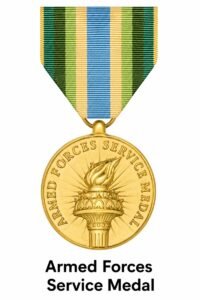
The Armed Forces Service Medal (AFSM) recognizes members of the United States Armed Forces who participate in significant U.S. military operations that do not involve foreign armed opposition or imminent hostile action. Although these operations are not considered combat missions, they often require extensive planning, coordination, and sustained military support in challenging environments.
Established in 1996, the Armed Forces Service Medal acknowledges the important role service members play in peacekeeping missions, humanitarian operations, international stability efforts, and other designated military activities. It honors those who contribute to national security and global stability through military service outside of traditional combat operations.
History of the Armed Forces Service Medal
The Armed Forces Service Medal was established by Executive Order 12985 on January 11, 1996.
Prior to its creation, many military operations that did not qualify for campaign or expeditionary medals lacked a specific award to recognize participant service. The Armed Forces Service Medal filled that gap by honoring personnel who took part in significant military operations involving no foreign armed opposition.
Since its establishment, the medal has been awarded for numerous approved operations around the world.
Purpose of the Armed Forces Service Medal
The Armed Forces Service Medal recognizes participation in important military operations that support U.S. national objectives without involving combat against hostile forces.
These operations may include:
- Peacekeeping missions
- International stabilization efforts
- Humanitarian support
- Security assistance
- Disaster response
- Large-scale military support operations
- International coalition missions
- Evacuation operations
The medal highlights the contributions of service members whose missions are vital to maintaining regional and global stability.
Who Is Eligible?
The Armed Forces Service Medal may be awarded to members of:
- United States Army
- United States Navy
- United States Marine Corps
- United States Air Force
- United States Space Force
- United States Coast Guard (when operating under Department of Defense authority)
Active-duty personnel, Reserve members, and National Guard members may qualify if they meet the eligibility requirements for an approved operation.
Eligibility Requirements
To receive the Armed Forces Service Medal, a service member generally must:
- Participate in a Department of Defense-designated military operation.
- Serve in the approved operational area during the designated eligibility period.
- Perform assigned duties supporting the mission.
- Meet any minimum time-in-theater requirements established for the operation.
- Be an active participant in the operation rather than serving in a remote support role.
Each approved operation has its own eligibility guidance established by the Department of Defense.
Approved Military Operations
The Armed Forces Service Medal is only awarded for operations specifically designated by the Department of Defense.
Examples have included:
- Peacekeeping missions
- NATO support operations
- Stability operations
- Humanitarian intervention missions
- International monitoring efforts
- Civil support operations
- Disaster relief missions
- Evacuation operations
Because military operations evolve over time, new qualifying operations may be approved when they meet established criteria.
Difference Between the Armed Forces Service Medal and the Armed Forces Expeditionary Medal
Although the names are similar, these two medals recognize different types of service.
The Armed Forces Service Medal is awarded for significant military operations where there is no foreign armed opposition or imminent hostile action.
The Armed Forces Expeditionary Medal generally recognizes participation in military operations involving potential or actual hostile conditions, where personnel deploy into designated expeditionary environments.
The Department of Defense determines which medal applies to each approved operation.
Time Requirements
Eligibility may require service members to spend a minimum number of consecutive or non-consecutive days in the designated operational area.
Certain exceptions may apply for personnel who:
- Are injured during the operation.
- Participate in combat support activities designated by the operation.
- Meet special mission requirements established by the Department of Defense.
The exact requirements depend on the approved military operation.
Medal and Ribbon Design
The Armed Forces Service Medal is made of bronze and features symbols representing military readiness, national service, and international cooperation.
Its service ribbon contains a distinctive combination of colors representing all branches of the U.S. Armed Forces and the joint nature of the missions recognized by the medal.
Additional Awards
A service member may qualify for more than one Armed Forces Service Medal if they participate in multiple qualifying operations.
Rather than receiving another medal, additional awards are shown with bronze service stars worn on the suspension ribbon and service ribbon.
Each bronze service star represents one additional qualifying operation.
How the Medal Is Awarded
Military units maintain official records identifying personnel who served during qualifying operations.
After eligibility is verified, commanders approve the award and it becomes part of the service member’s official military personnel record.
Supporting documentation may include:
- Deployment orders
- Unit rosters
- Personnel records
- Operation participation records
- Military assignments
- Official award authorization
Importance of the Armed Forces Service Medal
Many military operations require exceptional professionalism even when combat is not involved.
Service members awarded the Armed Forces Service Medal often serve in politically sensitive environments where diplomacy, peacekeeping, humanitarian support, and multinational cooperation are essential to mission success.
The medal recognizes these important contributions while acknowledging that military service extends far beyond traditional battlefield operations.
Frequently Asked Questions
Is the Armed Forces Service Medal a combat award?
No. It recognizes participation in designated military operations that do not involve foreign armed opposition or imminent hostile action.
Can Reserve and National Guard members receive the medal?
Yes. Reserve Component and National Guard personnel may qualify if they participate in an approved operation and meet all eligibility requirements.
Can someone receive the Armed Forces Service Medal multiple times?
Yes. Additional qualifying operations are recognized with bronze service stars instead of additional medals.
Who determines qualifying operations?
The Department of Defense designates which military operations qualify for the Armed Forces Service Medal and establishes the eligibility requirements for each operation.
Conclusion
The Armed Forces Service Medal honors U.S. military personnel who participate in significant operations that support peace, stability, humanitarian assistance, and national security without direct combat against hostile forces. Although these missions may not receive the same public attention as wartime deployments, they require dedication, professionalism, and teamwork. The medal serves as lasting recognition of the men and women whose service strengthens international partnerships and advances important military objectives around the world.