
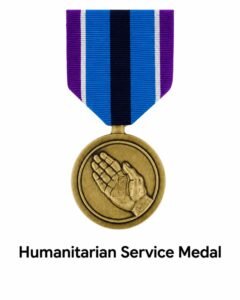
The Humanitarian Service Medal (HSM) recognizes members of the United States Armed Forces who directly participate in significant humanitarian operations. Unlike combat decorations, this medal honors military personnel whose service provides lifesaving assistance and relief to people affected by natural disasters, humanitarian crises, or other emergencies.
Established in 1977, the Humanitarian Service Medal highlights the military’s important role in disaster response, evacuation missions, refugee assistance, and relief operations around the world. Whether responding to hurricanes, earthquakes, floods, or humanitarian emergencies overseas, recipients demonstrate dedication, professionalism, and compassion while serving others.
History of the Humanitarian Service Medal
The Humanitarian Service Medal was established by President Gerald R. Ford through Executive Order 11965 on January 19, 1977.
Before its creation, military personnel who participated in humanitarian missions often received little formal recognition unless their service qualified for another military decoration. The Humanitarian Service Medal filled this gap by recognizing direct participation in Department of Defense-approved humanitarian operations.
Since its establishment, thousands of service members from every branch of the U.S. military have received the medal for their contributions to disaster relief and humanitarian assistance.
Purpose of the Medal
The Humanitarian Service Medal honors military personnel who provide direct support during humanitarian missions that significantly benefit civilian populations.
These missions may include:
- Disaster relief
- Emergency medical assistance
- Search and rescue operations
- Refugee support
- Food and water distribution
- Evacuation operations
- Humanitarian airlift missions
- Recovery assistance following natural disasters
The medal recognizes service that helps save lives and reduce suffering during times of crisis.
Who Is Eligible?
Members of the following branches may qualify:
- United States Army
- United States Navy
- United States Marine Corps
- United States Air Force
- United States Space Force
- United States Coast Guard (when operating under Department of Defense authority)
Reserve and National Guard members may also qualify if they actively participate in an approved humanitarian operation.
Eligibility Requirements
To receive the Humanitarian Service Medal, a service member generally must:
- Be on active duty or serving in an eligible military status.
- Participate directly in a Department of Defense-approved humanitarian operation.
- Provide direct support to the mission.
- Be physically present in the designated operational area during the approved dates.
- Meet all eligibility requirements established for the specific operation.
Simply being assigned to a unit involved in the mission does not automatically qualify an individual. Direct participation is required.
Approved Humanitarian Operations
Not every disaster response qualifies for the Humanitarian Service Medal.
The Department of Defense approves specific operations based on established criteria.
Examples of qualifying missions have included:
- Hurricane disaster relief
- Earthquake response
- Tsunami recovery efforts
- Wildfire emergency assistance
- Refugee evacuation operations
- Flood relief
- Pandemic-related support missions
- Humanitarian airlift operations
- International disaster assistance
Each approved operation includes specific eligibility dates and geographic locations.
What Does “Direct Participation” Mean?
Direct participation means actively performing duties that contribute to the humanitarian mission.
Examples include:
- Delivering emergency supplies
- Providing medical treatment
- Conducting rescue missions
- Operating aircraft supporting relief efforts
- Engineering support
- Restoring infrastructure
- Transporting displaced civilians
- Security for humanitarian operations
Administrative personnel working outside the approved operational area generally do not qualify.
Humanitarian Service Medal Appearance
The Humanitarian Service Medal is made of bronze and features a symbolic design representing service to humanity.
The ribbon includes colors that represent compassion, sacrifice, and service.
The ribbon contains:
- Light blue
- White
- Purple
- Green
These colors distinguish the Humanitarian Service Medal from other U.S. military decorations.
Multiple Awards
Service members may receive the Humanitarian Service Medal more than once.
Instead of receiving another medal, additional awards are indicated by bronze service stars worn on the suspension ribbon and service ribbon.
Each service star represents participation in another qualifying humanitarian operation.
Difference Between the Humanitarian Service Medal and Other Awards
The Humanitarian Service Medal differs from campaign and expeditionary medals because it recognizes humanitarian assistance rather than combat or military campaigns.
For example:
- Campaign medals recognize participation in military operations.
- Expeditionary medals recognize deployment to designated operations.
- Achievement medals recognize individual accomplishments.
- The Humanitarian Service Medal recognizes direct participation in approved humanitarian missions.
Although some humanitarian operations occur in dangerous environments, the medal is awarded for humanitarian service rather than combat.
Can Civilians Receive the Humanitarian Service Medal?
No.
The Humanitarian Service Medal is awarded only to eligible members of the United States Armed Forces who meet the established military eligibility requirements.
Civilian employees and contractors who support humanitarian missions may receive other forms of recognition but are not eligible for this military decoration.
How Is the Medal Awarded?
Military commanders verify that eligible personnel participated in an approved humanitarian operation.
After confirming eligibility, the award is entered into the service member’s official military personnel records and the medal is issued according to military regulations.
Documentation may include:
- Deployment records
- Unit assignments
- Official operation orders
- Personnel records
- Award approval documentation
Importance of the Humanitarian Service Medal
The Humanitarian Service Medal represents the military’s commitment to helping those in need during times of crisis.
Recipients often serve in difficult conditions, providing lifesaving aid after hurricanes, earthquakes, floods, fires, and humanitarian emergencies around the world. Their efforts reflect the Armed Forces’ dedication not only to national defense but also to humanitarian assistance and disaster relief.
For many service members, this medal symbolizes compassion, teamwork, and selfless service while supporting communities facing extraordinary challenges.
Frequently Asked Questions
Is the Humanitarian Service Medal a combat award?
No. It recognizes direct participation in approved humanitarian operations rather than combat service.
Can Reserve and National Guard members receive the medal?
Yes. They may qualify if they directly participate in an approved humanitarian mission while serving in an eligible military status.
Can someone receive the Humanitarian Service Medal more than once?
Yes. Additional qualifying operations are recognized with bronze service stars rather than multiple medals.
Who approves qualifying operations?
The Department of Defense designates which humanitarian operations qualify for the Humanitarian Service Medal and establishes the eligibility requirements for each mission.
Conclusion
The Humanitarian Service Medal honors the compassion, professionalism, and dedication of U.S. military personnel who provide critical assistance during humanitarian crises. Whether responding to natural disasters, supporting refugee operations, or delivering emergency aid, recipients play an essential role in protecting lives and helping communities recover. The medal stands as a lasting recognition of selfless service performed in support of people facing extraordinary hardship.