
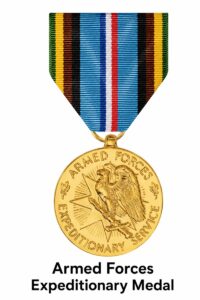
The Armed Forces Expeditionary Medal (AFEM) recognizes U.S. military personnel who participate in designated military operations after July 1, 1958. It honors service members who deploy in support of operations where no specific campaign medal has been authorized. The medal has been awarded for hundreds of operations worldwide, ranging from peacekeeping missions and humanitarian efforts to military interventions and contingency operations.
Although newer campaign medals have replaced the AFEM for many recent conflicts, it remains one of the most respected U.S. military expeditionary awards and continues to be awarded for qualifying operations approved by the Department of Defense.
History of the Armed Forces Expeditionary Medal
The Armed Forces Expeditionary Medal was established by President Dwight D. Eisenhower through Executive Order 10977 on December 4, 1961.
Before its creation, many military operations fell between traditional wartime campaigns and peacetime service, leaving no appropriate award to recognize participants. The AFEM filled this gap by providing recognition for service members deployed on significant military operations that did not qualify for a campaign-specific medal.
Since its creation, the medal has been awarded for operations across nearly every continent.
Who Can Receive the Armed Forces Expeditionary Medal?
The medal may be awarded to members of:
- U.S. Army
- U.S. Navy
- U.S. Marine Corps
- U.S. Air Force
- U.S. Coast Guard
- U.S. Space Force (when assigned to qualifying operations)
Personnel generally must participate in a designated military operation within an approved geographic area.
Eligibility Requirements
To qualify, service members generally must:
- Serve in a designated military operation approved by the Department of Defense.
- Be assigned to a participating unit.
- Enter the designated area of operations.
- Meet minimum time requirements unless engaged in combat or evacuated due to wounds or injuries.
Individual operations may establish additional eligibility requirements.
Time-in-Area Requirements
Most qualifying operations require one of the following:
- 30 consecutive days in the designated area
- 60 non-consecutive days in the area
Exceptions may apply if the individual:
- Engaged in actual combat
- Was wounded or injured requiring medical evacuation
- Flew qualifying combat or direct support missions
- Met operation-specific requirements
What Operations Qualify?
The Department of Defense designates qualifying operations individually. Some well-known operations include:
- Lebanon
- Grenada (Operation Urgent Fury)
- Panama (Operation Just Cause)
- Haiti
- Bosnia
- Kosovo
- Southern Watch
- Northern Watch
- Numerous peacekeeping and contingency operations
Not every deployment qualifies, and eligibility depends on the official list of approved operations.
Vietnam Service Exception
The Armed Forces Expeditionary Medal was originally awarded for service in Vietnam before the Vietnam Service Medal was established.
Many veterans became eligible to exchange the Armed Forces Expeditionary Medal for the Vietnam Service Medal. However, federal policy generally prohibits receiving both medals for the same period of service.
Humanitarian and Peacekeeping Missions
The AFEM has frequently recognized service members supporting:
- Peacekeeping operations
- Crisis response missions
- Military evacuations
- International security operations
- Armed interventions
- Stabilization missions
Some humanitarian missions instead qualify for the Humanitarian Service Medal, depending on Department of Defense authorization.
Medal Design
The medal is bronze and measures approximately 1¼ inches in diameter.
Obverse
The front features:
- An eagle
- A drawn sword
- A radiant compass rose
- The inscription:
ARMED FORCES EXPEDITIONARY SERVICE
Reverse
The reverse displays:
- The shield from the U.S. Coat of Arms
- Laurel branches
- The words:
UNITED STATES OF AMERICA
Ribbon Colors
The ribbon includes several distinctive colors:
- Green
- Golden Yellow
- Brown
- Black
- Light Blue
- White
- Red
- Blue
The combination symbolizes military readiness, service, courage, and the joint nature of expeditionary operations.
Bronze Service Stars
Bronze service stars may be worn to indicate participation in additional qualifying operations.
For example:
- AFEM with one Bronze Service Star = Two qualifying operations
- AFEM with two Bronze Service Stars = Three qualifying operations
Each approved operation counts separately.
Order of Precedence
The Armed Forces Expeditionary Medal is worn according to the official U.S. Military Awards Order of Precedence established by each service branch.
It is generally worn among campaign and expeditionary medals and before many service medals.
Difference Between the Armed Forces Expeditionary Medal and Armed Forces Service Medal
Although their names are similar, they recognize different types of service.
| Armed Forces Expeditionary Medal | Armed Forces Service Medal |
|---|---|
| Expeditionary operations | Non-combat significant operations |
| Often involves deployment into operational areas | Usually supports major operations without combat |
| May include combat situations | Generally no hostile action expected |
| Established in 1961 | Established in 1996 |
How Is the Medal Awarded?
Awards are processed through each military service after verifying:
- Assignment records
- Deployment history
- Official orders
- Eligible operation dates
- Geographic service
The medal is entered into the service member’s official military record.
Can Veterans Request a Replacement?
Yes. Veterans may request replacement medals if they were:
- Lost
- Damaged
- Stolen
- Never received
Requests generally require proof of military service and eligibility through the appropriate military records office.
Collecting the Armed Forces Expeditionary Medal
Collectors often seek:
- Original government-issued medals
- Full-size medals
- Miniature medals
- Ribbon bars
- Presentation cases
- Named award sets
- Complete deployment groups
Condition, documentation, and accompanying records significantly affect collector value.
Interesting Facts
- The AFEM has recognized service in dozens of countries.
- It predates many modern campaign medals.
- Some service members have earned multiple awards through different operations.
- It remains one of the most frequently recognized expeditionary medals in U.S. military history.
- New qualifying operations may be authorized by the Department of Defense as needed.
Conclusion
The Armed Forces Expeditionary Medal honors military personnel who deploy in support of important U.S. operations around the world when no campaign-specific medal exists. Since its establishment in 1961, it has recognized generations of service members who answered the call during peacekeeping missions, military interventions, evacuations, and other expeditionary operations. For veterans and collectors alike, the AFEM represents dedicated service, readiness, and the global reach of the United States Armed Forces.
Related Articles
- Armed Forces Service Medal
- Global War on Terrorism Expeditionary Medal
- Humanitarian Service Medal
- Military Awards Order of Precedence
- Military Ribbon Charts
- Military Medal Identification Guide
- Military Ribbon & Device Identification Guide
- Campaign & War Medals
- Service & Achievement Medals
- How to Replace Lost Military Medals