
The Distinguished Service Medal (DSM) is one of the highest military decorations awarded by the United States Army. It recognizes exceptionally meritorious service performed in a position of great responsibility. Rather than honoring a single act of heroism, the medal acknowledges sustained leadership and extraordinary contributions that have significantly strengthened the Army and national defense.
The Distinguished Service Medal is typically awarded to senior military leaders whose decisions have had a lasting impact on military operations, readiness, or strategic planning. Although it is most often associated with generals and other high-ranking officers, it may be awarded to any service member whose service meets the exceptionally high standards required.
History of the Distinguished Service Medal
The Distinguished Service Medal was established by Congress in 1918 during World War I. The Army needed a decoration to recognize exceptionally meritorious service that did not necessarily involve direct combat heroism.
Since its creation, the medal has honored military leaders whose vision, command ability, and dedication have improved the effectiveness of the United States Army during both wartime and peacetime.
Today, it remains one of the Army’s most prestigious awards for distinguished service.
Who Can Receive the Distinguished Service Medal?
The Distinguished Service Medal may be awarded to members of the United States Army who perform exceptionally meritorious service while serving in positions of great responsibility.
Recipients commonly include:
- General officers
- Senior commanders
- Army staff leaders
- Commanding generals
- Senior officials responsible for major Army operations
While senior leadership positions are common among recipients, the award is based on exceptional service rather than rank alone.
Eligibility Requirements
To qualify for the Distinguished Service Medal, a service member must demonstrate:
- Exceptionally meritorious service
- Outstanding leadership
- Exceptional performance in a position of great responsibility
- Major contributions to Army readiness or national defense
- Sustained accomplishments that exceed normal expectations
The medal recognizes service that has a broad and lasting impact on the Army.
What Does the Medal Look Like?
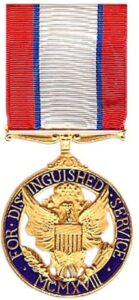
The Distinguished Service Medal is a bronze medal featuring the Great Seal of the United States surrounded by a wreath, symbolizing honor, leadership, and faithful service.
Its ribbon is predominantly scarlet with narrow blue and white stripes near each edge, reflecting the national colors and the traditions of the United States Army.
The design represents distinguished service performed with integrity, dedication, and exceptional leadership.
How Is the Medal Awarded?
Recommendations are initiated through the chain of command and supported by detailed documentation outlining the recipient’s accomplishments.
Each nomination undergoes careful review before final approval by Army leadership.
Because the Distinguished Service Medal represents one of the Army’s highest honors, every recommendation must clearly demonstrate extraordinary service that exceeds the responsibilities of the position held.
Order of Precedence
The Distinguished Service Medal ranks among the Army’s highest awards for non-combat service. It is worn above many other service decorations and reflects exceptional leadership at the highest levels of responsibility.
Additional awards of the medal are indicated by authorized oak leaf clusters.
Notable Recipients
Over the years, the Distinguished Service Medal has been awarded to many of the Army’s most respected leaders. Recipients have included commanding generals, Chiefs of Staff, senior combat commanders, and military officials whose leadership has shaped Army doctrine, readiness, modernization, and national defense policy.
Many recipients have served during major conflicts while others have been recognized for decades of distinguished peacetime leadership.
Why the Distinguished Service Medal Matters
The Distinguished Service Medal recognizes leadership that extends well beyond individual accomplishments. Recipients often oversee large organizations, manage complex military operations, or develop policies that affect the entire Army.
Their work influences training, logistics, personnel management, force readiness, and strategic planning. Although their achievements may not always receive public attention, their decisions directly contribute to the success of military missions around the world.
The medal also reflects the Army’s commitment to recognizing sustained excellence, professionalism, and service to the nation.
Legacy
The Distinguished Service Medal continues to represent one of the highest honors the United States Army can bestow. It recognizes exceptional leaders whose dedication, judgment, and commitment have strengthened the Army and enhanced the nation’s security.
Awarded only to those whose service is truly extraordinary, the Distinguished Service Medal remains a lasting symbol of excellence, leadership, and unwavering devotion to duty.
Explore More Military Awards
If you’d like to learn more about military medals, decorations, ribbons, badges, unit awards, and award eligibility, visit our Military Awards and Decorations: The Complete Guide, which serves as the central resource for all military awards topics.