
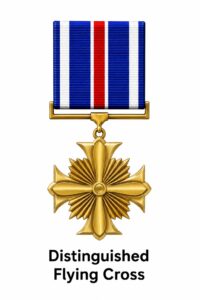
The Distinguished Flying Cross (DFC) is one of the United States military’s most prestigious decorations for heroism and extraordinary achievement during aerial flight. Awarded to members of the U.S. Armed Forces, the medal recognizes pilots, aircrew members, and others whose exceptional actions in the air demonstrate courage, skill, and dedication beyond what is normally expected.
Since its creation in the early twentieth century, the Distinguished Flying Cross has honored thousands of military aviators who risked their lives during combat operations, humanitarian missions, search and rescue efforts, and other dangerous flying assignments. Whether earned by a fighter pilot in wartime or a helicopter crew rescuing civilians from disaster, the award represents excellence in military aviation.
What Is the Distinguished Flying Cross?
The Distinguished Flying Cross is awarded for heroism or extraordinary achievement while participating in aerial flight. Unlike medals that recognize ground combat or lengthy military service, this decoration specifically honors exceptional performance during aviation missions.
The award may recognize a single act of heroism, such as protecting fellow service members during enemy attack, or sustained extraordinary achievement over multiple flying missions. Regardless of the circumstances, recipients must demonstrate outstanding skill, sound judgment, and exceptional courage while operating in the air.
The Distinguished Flying Cross is considered one of the highest aviation awards presented by the U.S. military and remains an important symbol of excellence among military aviators.
History of the Distinguished Flying Cross
The Distinguished Flying Cross was established by Congress on July 2, 1926, during a period when military aviation was rapidly evolving. As aircraft became increasingly important to national defense, military leaders recognized the need for a decoration specifically honoring exceptional accomplishments in flight.
One of the earliest recipients was famed aviator Charles Lindbergh, whose historic nonstop solo flight across the Atlantic Ocean demonstrated the growing importance of aviation. His achievement helped bring national attention to the award and inspired future generations of military pilots.
During World War II, the Distinguished Flying Cross became one of the most frequently awarded decorations for combat aviators. Thousands of Army Air Forces, Navy, Marine Corps, and Coast Guard personnel earned the medal for bombing missions, fighter escorts, reconnaissance flights, and rescue operations.
The medal has continued to be awarded during the Korean War, Vietnam War, Gulf War, operations in Iraq and Afghanistan, and numerous peacetime missions involving exceptional aerial achievement.
Who Can Receive the Medal?
The Distinguished Flying Cross may be awarded to members of every branch of the United States Armed Forces, including:
- Army
- Navy
- Marine Corps
- Air Force
- Coast Guard
- Space Force (for qualifying personnel participating in aerial operations)
Although the award is commonly associated with pilots, recipients may also include:
- Flight engineers
- Helicopter crews
- Combat systems officers
- Navigators
- Aircrew members
- Medical evacuation crews
- Other military personnel whose duties involve aerial flight
In certain circumstances, civilians or foreign military personnel serving alongside U.S. forces have also been authorized to receive the decoration.
Eligibility Requirements
To receive the Distinguished Flying Cross, an individual must distinguish themselves through heroism or extraordinary achievement while participating in aerial flight.
Examples of qualifying actions include:
- Completing dangerous combat missions under enemy fire
- Successfully rescuing personnel during hazardous flight operations
- Demonstrating exceptional flying skill during emergency situations
- Leading complex aviation missions with outstanding results
- Performing lifesaving actions while operating military aircraft
Routine flight duties alone are not sufficient for the award. The individual’s actions must clearly exceed normal expectations and involve significant risk or exceptional accomplishment.
Each recommendation is carefully reviewed through the military chain of command before final approval.
What Does the Distinguished Flying Cross Look Like?
The Distinguished Flying Cross features a bronze cross with propeller blades extending between each arm, symbolizing military aviation. At the center is a four-bladed propeller surrounded by rays representing achievement and courage in flight.
The reverse side includes space for engraving the recipient’s name and service information.
Its ribbon consists of deep blue with narrow white stripes near each edge, creating a distinctive appearance that is easily recognized among military decorations.
The design reflects both the history of military aviation and the bravery required to perform dangerous missions in the air.
How the Award Is Approved
Receiving the Distinguished Flying Cross involves a detailed nomination and approval process.
The typical process includes:
- Recommendation by commanders or supervisors
- Collection of eyewitness statements and mission reports
- Documentation of the heroic action or extraordinary achievement
- Review by multiple command levels
- Final approval by the appropriate military authority
Because the Distinguished Flying Cross recognizes exceptional performance, recommendations undergo careful scrutiny to ensure recipients meet the high standards established for the award.
Presentation ceremonies are often conducted before fellow service members, family members, and senior military leaders in recognition of the recipient’s outstanding accomplishments.
Notable Distinguished Flying Cross Recipients
Many distinguished military aviators have received the Distinguished Flying Cross throughout American history.
Recipients include fighter pilots, bomber crews, helicopter pilots, rescue teams, astronauts with military service, and special operations aviation personnel. Some earned the award for repeated combat missions, while others were recognized for a single act of extraordinary heroism.
During World War II, countless bomber and fighter crews received the medal for surviving dangerous missions over Europe and the Pacific. In later conflicts, helicopter crews frequently earned the award for evacuating wounded personnel under enemy fire and conducting daring search-and-rescue missions.
The medal continues to recognize military aviation professionals whose courage and skill contribute directly to mission success.
Why the Distinguished Flying Cross Is Important
The Distinguished Flying Cross represents the unique risks faced by military personnel who serve in the air. Aviation missions often require split-second decision-making under life-threatening conditions, where mistakes can have immediate consequences.
The medal honors individuals who demonstrate exceptional professionalism, courage, and dedication while carrying out those missions. It also highlights the critical role military aviation plays in national defense, humanitarian relief, disaster response, intelligence gathering, and combat operations.
For recipients and their families, the Distinguished Flying Cross becomes a lasting reminder of remarkable service and sacrifice.
Conclusion
The Distinguished Flying Cross remains one of the United States military’s most respected aviation decorations. Awarded for heroism and extraordinary achievement during aerial flight, it recognizes individuals who perform beyond the normal call of duty while operating in some of the most demanding environments imaginable.
From its establishment in 1926 to the present day, the Distinguished Flying Cross has honored generations of military aviators whose courage, expertise, and commitment have helped shape the history of American military aviation. Every medal awarded represents a story of skill, determination, and service that continues to inspire future generations of airmen and aviators.
Explore More Military Awards
If you’d like to learn more about military medals, decorations, ribbons, badges, unit awards, and award eligibility, visit our Military Awards and Decorations: The Complete Guide, which serves as the central resource for all military awards topics.