
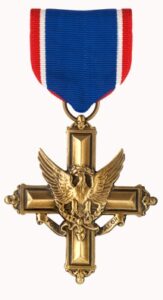
The Distinguished Service Cross (DSC) is the United States Army’s second-highest military decoration for valor, ranking only behind the Medal of Honor. It is awarded to soldiers who display extraordinary heroism while engaged in combat with an enemy of the United States. The acts of bravery recognized by the Distinguished Service Cross involve exceptional courage and selfless devotion to duty, often at great personal risk.
Since its establishment during World War I, the Distinguished Service Cross has honored thousands of soldiers whose heroic actions inspired their fellow service members and upheld the highest traditions of military service. It remains one of the Army’s most prestigious and respected decorations.
History of the Distinguished Service Cross
The Distinguished Service Cross was established by an Act of Congress on January 2, 1918, during World War I. Military leaders recognized the need for a decoration to honor acts of extraordinary heroism that did not meet the exceptionally high standard required for the Medal of Honor.
Originally, the medal recognized heroism performed during World War I, but it has since been awarded in every major U.S. conflict, including World War II, the Korean War, the Vietnam War, the Gulf War, the wars in Iraq and Afghanistan, and other military operations involving the U.S. Army.
Over the years, several Distinguished Service Cross awards have been upgraded to the Medal of Honor after additional reviews of battlefield actions and historical records.
Eligibility
The Distinguished Service Cross is awarded to members of the United States Army who distinguish themselves through extraordinary heroism while engaged in combat.
To qualify, a service member must demonstrate:
- Extraordinary heroism against an armed enemy.
- Courage that goes well beyond the normal call of duty.
- Actions involving significant personal danger.
- Heroic conduct that does not meet the criteria for the Medal of Honor.
The award may also be presented to qualifying members of allied foreign military forces serving alongside the U.S. Army under certain circumstances.
Medal Appearance
The Distinguished Service Cross is made of bronze and features a cross with an American bald eagle at its center. The eagle is surrounded by a green enamel wreath symbolizing honor, victory, and military achievement.
The reverse of the medal contains a space for engraving the recipient’s name and is inscribed with the words:
FOR VALOR
The medal is suspended from a blue ribbon with narrow white stripes and a broad red center stripe, creating one of the most recognizable ribbons in the U.S. military awards system.
Ribbon Description
The Distinguished Service Cross ribbon consists of:
- Dark blue outer sections
- Narrow white stripes
- A wide scarlet red center stripe
The ribbon’s patriotic colors reflect the values of courage, honor, and sacrifice associated with the award.
Award Criteria
Receiving the Distinguished Service Cross requires formal recommendations supported by eyewitness statements, official reports, and a detailed review through the Army awards approval process.
Examples of qualifying actions include:
- Leading a successful assault while under intense enemy fire.
- Rescuing wounded soldiers despite overwhelming danger.
- Continuing to fight after being seriously wounded.
- Defending fellow service members through exceptional acts of courage.
Each recommendation undergoes careful review to ensure the recipient’s actions meet the stringent standards established for the award.
Order of Precedence
The Distinguished Service Cross is the Army’s second-highest award for valor.
It is worn immediately after the Medal of Honor and before the Silver Star in the U.S. military order of precedence.
Notable Recipients
Many highly decorated soldiers have received the Distinguished Service Cross for extraordinary heroism, including:
- Douglas MacArthur
- George S. Patton
- Matthew Ridgway
- Norman Schwarzkopf Jr.
Thousands of other soldiers, many whose names are less widely known, have earned the Distinguished Service Cross through remarkable acts of battlefield heroism.
Frequently Confused With
The Distinguished Service Cross is often confused with the Medal of Honor because both recognize exceptional combat heroism.
The primary difference is that the Medal of Honor is reserved for acts of conspicuous gallantry and intrepidity above and beyond the call of duty, while the Distinguished Service Cross recognizes extraordinary heroism of an exceptionally high level that falls just below the Medal of Honor standard.
It is also distinct from the Navy Cross and Air Force Cross, which serve as the equivalent second-highest valor awards for their respective military branches.
Interesting Facts
- Established in 1918 during World War I.
- It is the Army’s second-highest award for valor.
- Awarded only for extraordinary heroism in combat.
- Several Distinguished Service Cross awards have later been upgraded to the Medal of Honor.
- It is one of the most respected decorations in the U.S. Army.
Conclusion
The Distinguished Service Cross honors soldiers whose extraordinary heroism demonstrates the highest ideals of courage, leadership, and devotion to duty under enemy fire. As the Army’s second-highest decoration for valor, it recognizes individuals who willingly placed themselves in extreme danger to protect others and accomplish the mission. The Distinguished Service Cross remains a lasting symbol of selfless service and exceptional battlefield bravery.
Explore More Military Awards
If you’d like to learn more about military medals, decorations, ribbons, badges, unit awards, and award eligibility, visit our Military Awards and Decorations: The Complete Guide, which serves as the central resource for all military awards topics.