
Understanding the Military Awards Order of Precedence
The military awards order of precedence determines how medals, ribbons, badges, and decorations are arranged and worn on a military uniform. Every award has an official place based on its level of importance and the type of recognition it represents. This standardized system ensures consistency across the United States Armed Forces while honoring the significance of each decoration.
Whether a service member has earned one medal or dozens, awards are always displayed according to official regulations rather than the order in which they were received. Valor decorations generally rank above meritorious service awards, while campaign medals, service ribbons, unit awards, and qualification badges follow according to established guidelines.
Understanding the order of precedence helps active-duty personnel, veterans, collectors, and military families properly identify and display military awards while preserving the traditions and standards of military service.
What Is the Order of Precedence?
The order of precedence is the official ranking system used to organize military awards.
It establishes how decorations are:
- Worn on military uniforms
- Displayed in shadow boxes
- Listed in military records
- Arranged on ribbon racks
- Presented during military ceremonies
Rather than reflecting when an award was earned, the order of precedence reflects the importance and purpose of each decoration.
This standardized system allows military personnel across all branches to display awards consistently.
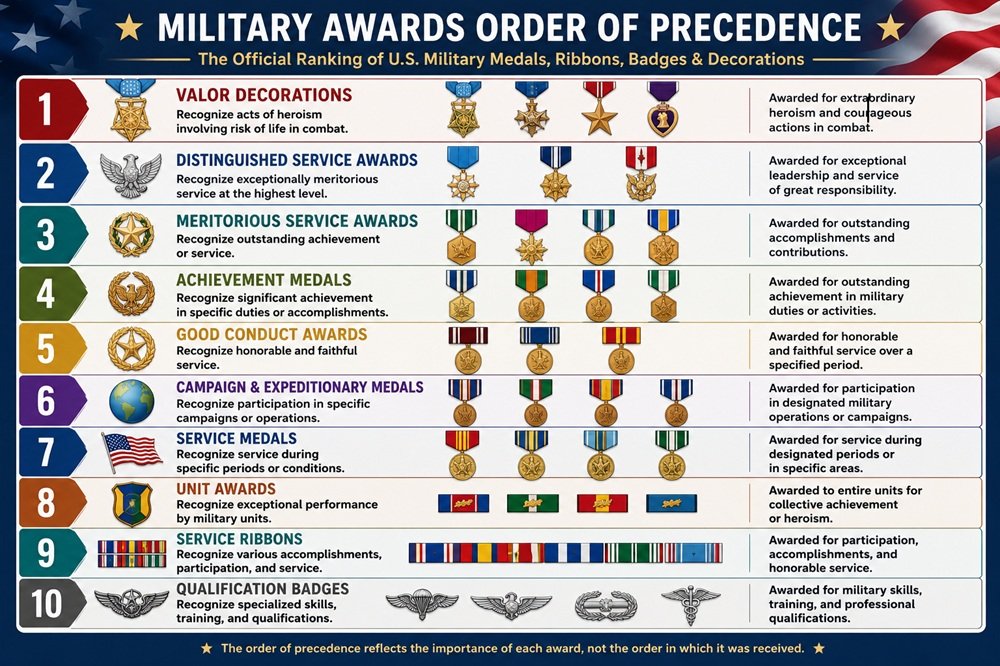
Why the Order of Precedence Matters
Military decorations represent significant achievements, acts of courage, faithful service, and participation in military operations.
Displaying awards correctly demonstrates:
- Respect for military traditions
- Compliance with military regulations
- Recognition of award significance
- Professional military appearance
- Historical accuracy
Following the official order also ensures that the nation’s highest military honors receive the prominence they deserve.
How Military Awards Are Ranked
Military awards are generally organized into categories based on the type of recognition they represent.
Although each military branch publishes its own regulations, the overall structure is similar throughout the Armed Forces.
Awards are typically ranked in the following order:
- Valor decorations
- Distinguished service awards
- Meritorious service decorations
- Achievement medals
- Good conduct awards
- Campaign and expeditionary medals
- Service medals
- Unit awards
- Service ribbons
- Qualification badges
Each category contains individual awards that follow their own official ranking.
Valor Awards Receive the Highest Priority
Valor decorations recognize extraordinary heroism in combat and occupy the highest positions in the military awards order of precedence.
These decorations honor service members whose actions demonstrated exceptional courage while facing enemy forces.
Because of their extraordinary significance, valor awards are always worn before decorations recognizing achievement, service, or participation.
Only a small number of service members receive these prestigious honors, making them among the military’s most respected decorations.
Service and Achievement Awards
Following valor decorations are awards recognizing leadership, exceptional performance, and honorable military service.
These awards acknowledge accomplishments such as:
- Outstanding leadership
- Professional excellence
- Exceptional duty performance
- Career accomplishments
- Long-term honorable service
While these awards may not involve combat heroism, they remain important recognitions of military excellence.
Campaign and Service Medals
Campaign medals recognize participation in specific military operations or designated periods of service.
Examples may include service during:
- Overseas deployments
- Military campaigns
- Humanitarian missions
- Expeditionary operations
- National defense periods
Campaign medals generally rank below personal decorations but above many service ribbons and qualification awards.
Their placement reflects participation in significant military operations rather than individual acts of heroism.
Unit Awards
Unit awards recognize exceptional performance by an entire military organization rather than an individual service member.
A veteran may wear a unit award if they served with the organization during the approved award period.
Examples recognize units for:
- Combat excellence
- Heroic action
- Outstanding mission performance
- Exceptional collective achievement
Although unit awards are highly respected, they typically follow personal decorations in the order of precedence.
Qualification Badges and Ribbons
Qualification badges recognize specialized military skills, training, and occupational qualifications.
Examples include badges earned through:
- Airborne training
- Aviation service
- Marksmanship
- Diving
- Medical specialties
- Special operations
Service ribbons also recognize various accomplishments and periods of honorable service.
These awards are generally worn after higher-ranking personal decorations and campaign medals according to branch regulations.
Branch Differences in Award Precedence
While the Department of Defense establishes many common military awards, each branch publishes its own order of precedence regulations.
Differences may include:
- Branch-specific decorations
- Unique badges
- Ribbon placement
- Uniform regulations
- Administrative guidance
Despite these differences, the overall ranking principles remain consistent across the Army, Navy, Marine Corps, Air Force, Space Force, and Coast Guard.
Displaying Military Awards Correctly
Military awards are often displayed outside of the uniform as part of a veteran’s personal history.
Awards may be displayed in:
- Shadow boxes
- Memorial displays
- Retirement presentations
- Museum exhibits
- Family collections
When arranging awards for display, veterans often follow the official order of precedence to preserve historical accuracy and properly recognize the significance of each decoration.
Proper display also helps educate future generations about military service and achievement.
Explore More Military Awards
If you’d like to learn more about military medals, decorations, ribbons, badges, unit awards, and award eligibility, visit our Military Awards and Decorations: The Complete Guide, which serves as the central resource for all military awards topics.
Final Thoughts
The military awards order of precedence provides a standardized system for arranging medals, ribbons, badges, and decorations according to their official importance. Rather than reflecting when an award was earned, the order recognizes the significance of each decoration and preserves the traditions of military service across every branch of the Armed Forces.
Understanding the order of precedence helps service members wear their awards correctly, assists veterans in creating accurate display cases, and allows families to better appreciate the meaning behind each medal and ribbon. By following official military regulations, the honor associated with every military award continues to be preserved for generations to come.